


.png?width=26&height=26&name=youtubemobile%20(Custom).png)
.png?width=26&height=26&name=instgrammobile%20(Custom).png)


Have you ever wondered how to take the best photographs of your classic car? Perhaps you are...
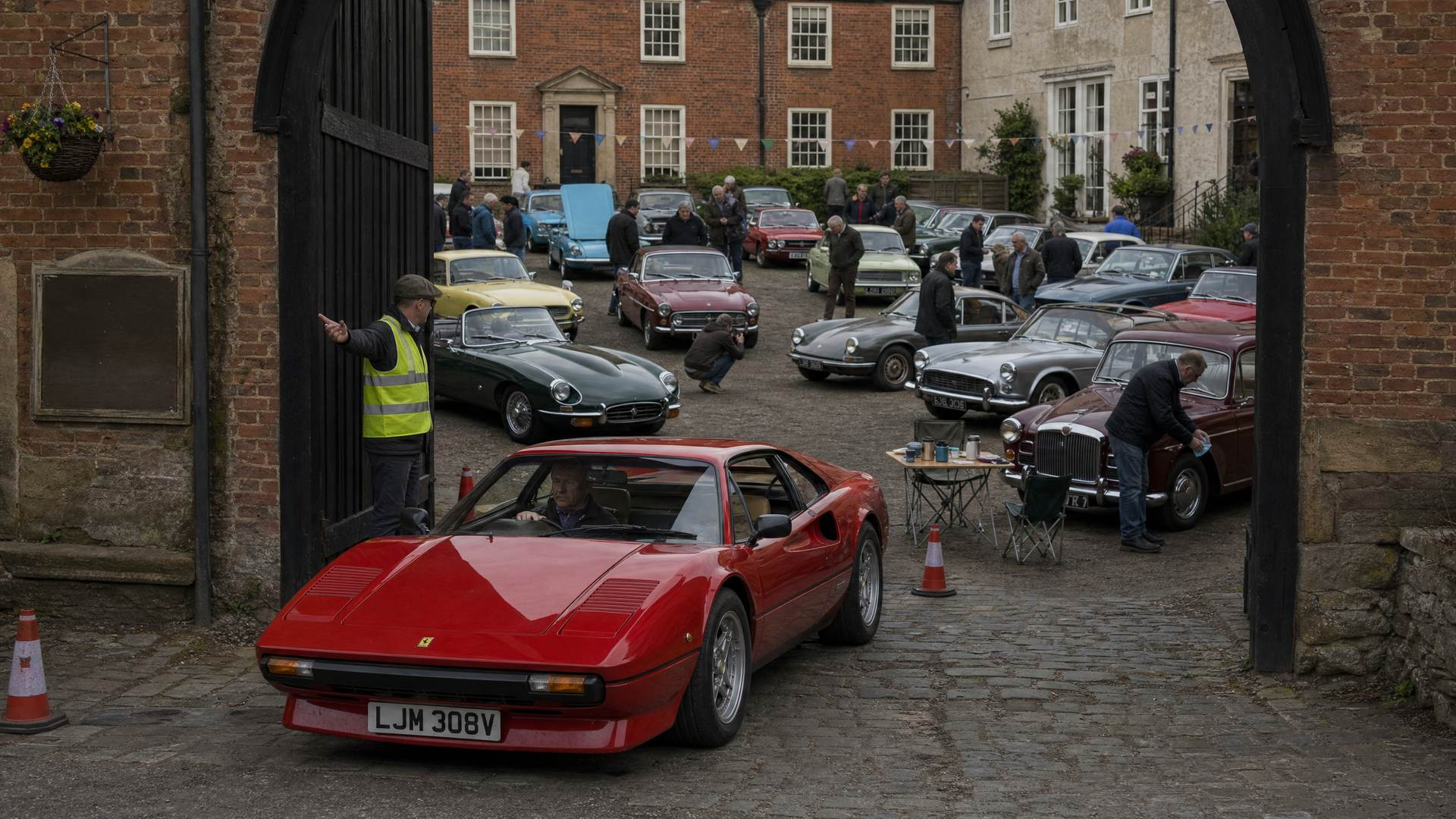




Who gets the prime spot by the door, and why is it always the guy with the MGB who arrived three hours early?
A classic car pub meet may look wonderfully casual from the road. A few old motors, some folding chairs and a loose cloud of people holding mugs with both hands. Look closer, though, and the car park is less democratic than the House of Lords. Every space has a status attached to it, every arrival is quietly assessed, and everybody knows who has parked badly even if nobody is prepared to say it before breakfast.
The top spot is beside the pub door, where passing families can admire your car on their way in for lunch. This space always belongs to the MGB owner who arrived while the chef was still in bed. He claims the roads were unusually clear and he simply happened to be passing. The flask, folding chair and small bag of polishing cloths suggest otherwise. By the time everyone else arrives, he has already removed three flies from the grille and developed strong opinions about the gravel.
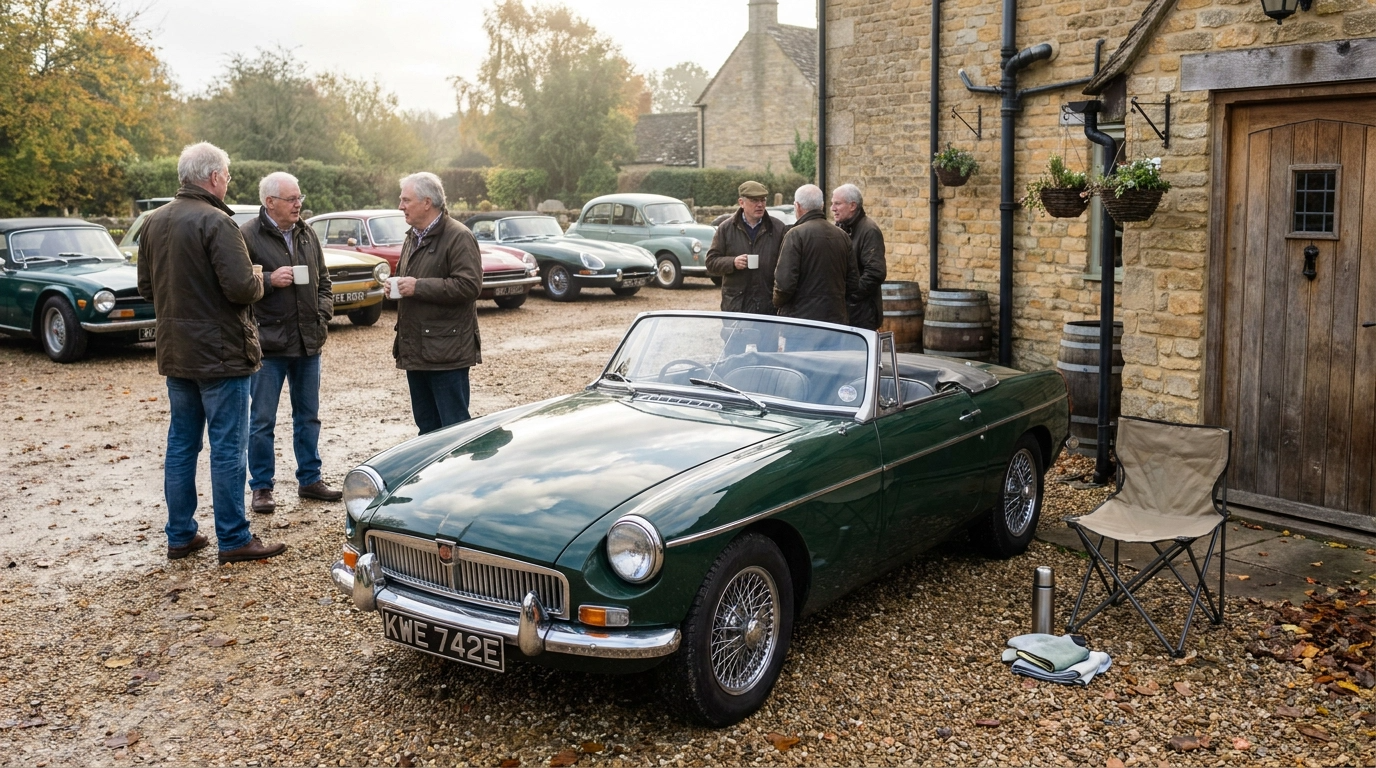
The man who beat breakfast
Nobody officially gave the MGB owner authority, but authority has found him. He greets each new car with a slow nod, points vaguely towards the remaining spaces and says things like, “You might squeeze in by the wall.” He knows which patch gathers a puddle, where the brewery lorry turns and which bay gets attacked by sap from the sycamore. This is not parking information. It is territorial intelligence.
His position has very little to do with rarity or value. An MGB is hardly an unexpected sight at a British classic meet, which is part of its charm. The prime spot is his because he put in the hours. Anyone can buy an exotic car if their bank manager has stopped returning calls, but arriving at a rural pub before the first rasher of bacon reaches the pan takes commitment. In the pub car park hierarchy, punctuality beats provenance.
The invisible velvet rope
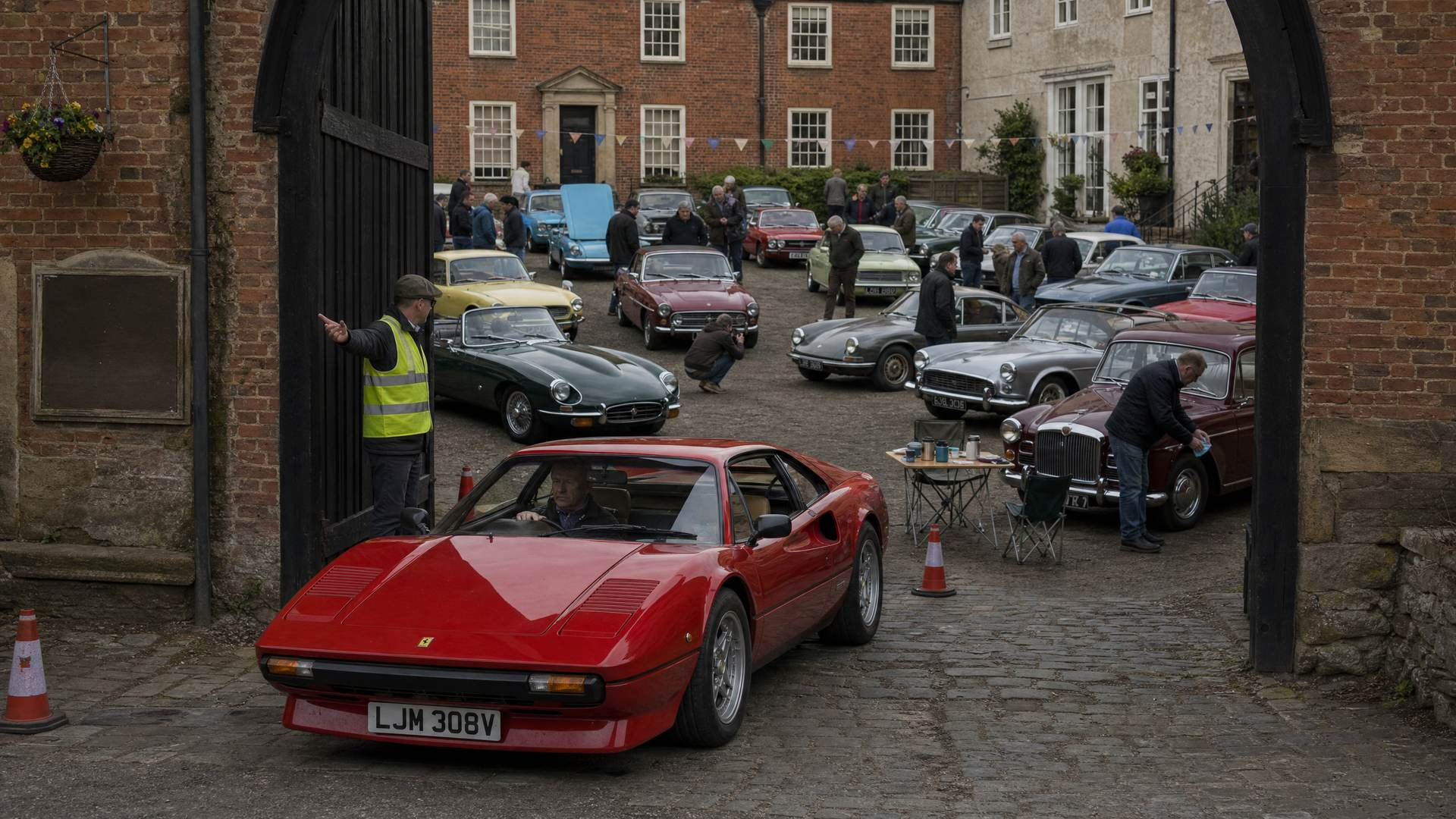
Then something expensive arrives. You hear it before you see it, usually while somebody is halfway through saying that modern cars all sound the same. A Ferrari, Maserati or immaculate Jaguar E Type noses through the entrance, and every conversation pauses for exactly one second. Everyone then carries on talking with exaggerated casualness while turning their entire body towards the noise.
The exotic receives an invisible exclusion zone. Nobody parks too close, nobody leans against it and people carrying tea suddenly become very conscious of their elbows. The owner reverses into position while six strangers offer six different hand signals, none of which has an agreed meaning. Once parked, he locks it, checks the handle, walks away, looks back, then finds a window seat from which he can monitor anyone under the age of twelve.
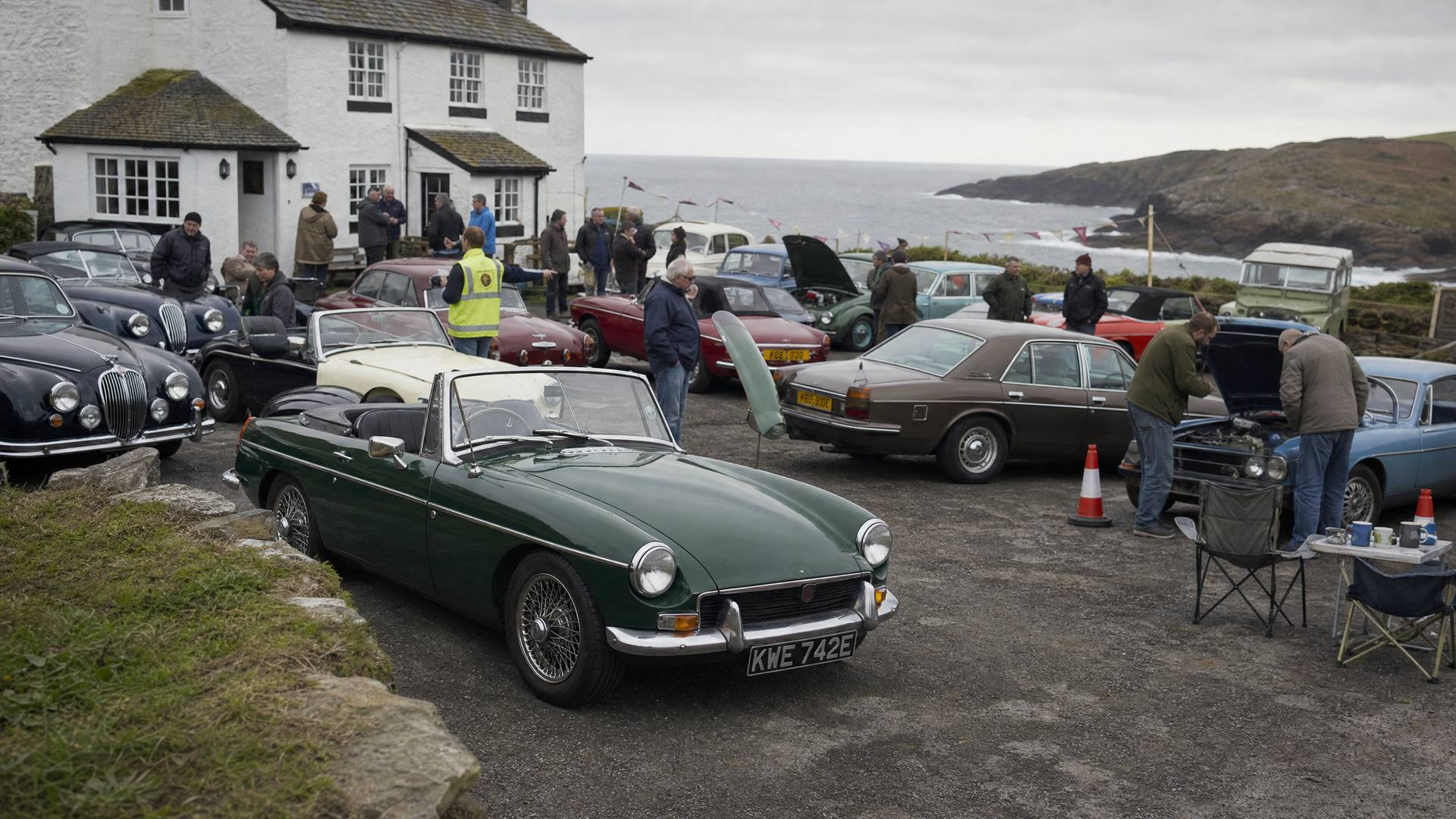
Patina outranks polish
Oddly, the car that often draws the warmest crowd is not the expensive one at all. It is the scruffy survivor that looks as though it came straight from the school run in 1987 and never quite stopped. There is a dent in one wing, the paint has several interpretations of blue, and a club badge on the grille appears to be the only thing holding the front together.
Its owner calls the finish patina. His partner calls it the reason their garage smells damp. Children love it because they are allowed to touch it, older visitors start telling stories about the one their father had, and somebody inevitably says, “You never see these anymore.” A flawless restoration wins admiration. A slightly disreputable Morris, Marina or Volvo wins affection, which is much harder to achieve with a polishing machine.
The unpaid technical lecture
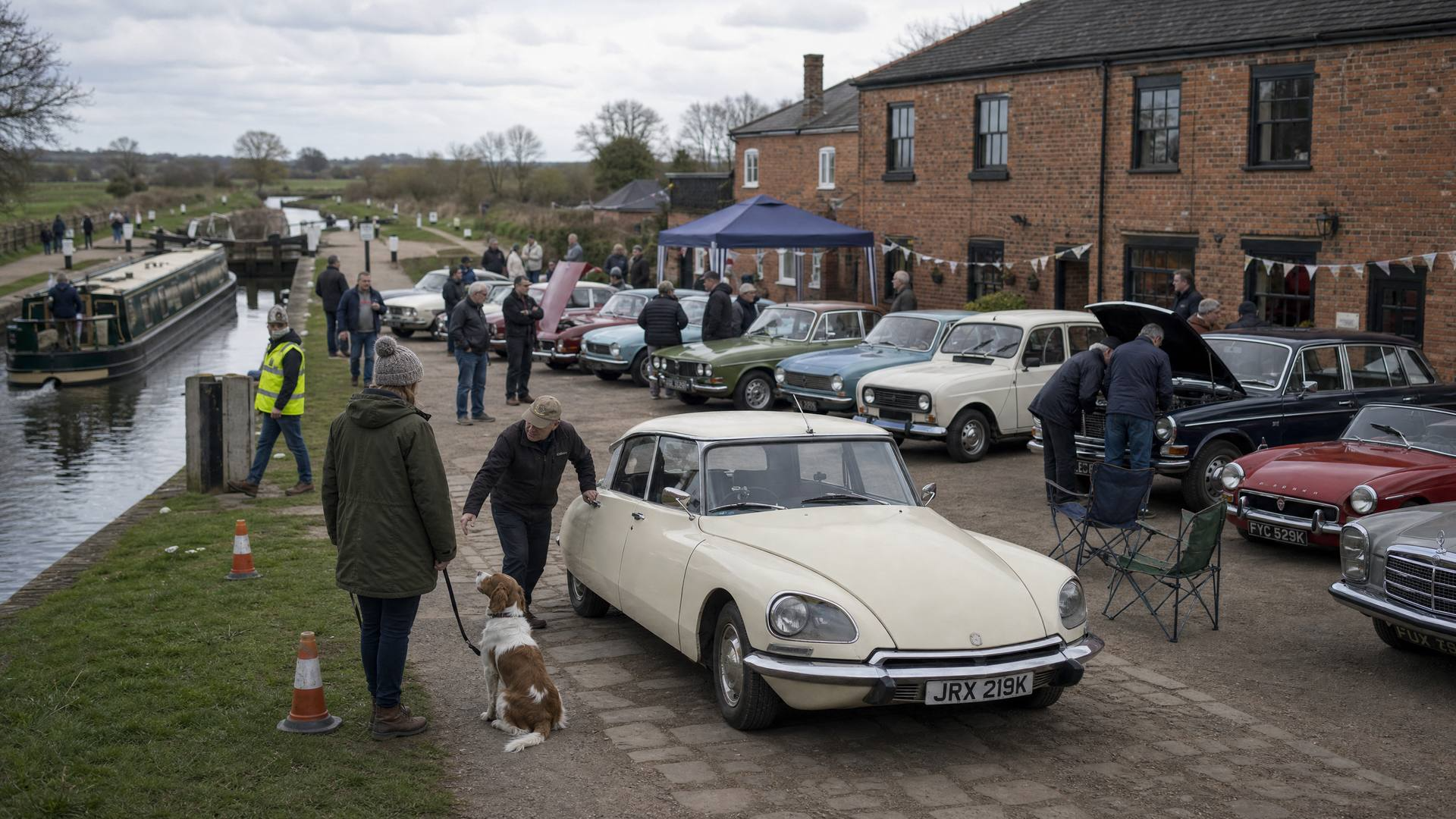
Every meet has an explainer. He usually owns something clever, unusual or French. If it is a Citroën DS, the hydropneumatic suspension will rise gracefully as the engine starts, and so will his right index finger. Within moments he is explaining the system to a man who only stepped outside to find his dog. The dog understands that escape is now impossible and lies down.
Nearby is the owner who has brought a folder. Not a small folder either, but a full motoring archive with invoices, photographs, old tax discs, wiring diagrams and correspondence from a parts supplier who retired in 2004. Ask one innocent question and a folding table appears. You wanted to know the year. You are now on page 46 of a documented gearbox rebuild and it would be rude to leave before the new bearings arrive.
The republic of the grass verge
The Series Land Rover does not require a marked bay because it has four wheel drive and a sense of entitlement. It parks on the grass verge, partly to demonstrate capability and partly because the owner enjoys telling people that ordinary cars could never get up there. The verge is six inches higher than the tarmac. A mobility scooter has already managed it.
Mud is important here. Too little and the vehicle looks ornamental. Too much and somebody may ask where it has been, which creates the risk of having to invent a convincing answer. The ideal coating suggests an urgent mission across Salisbury Plain but is still clean enough not to soil the waxed jacket. There may be a shovel attached somewhere. The shovel has a quieter social life than most garden tools.
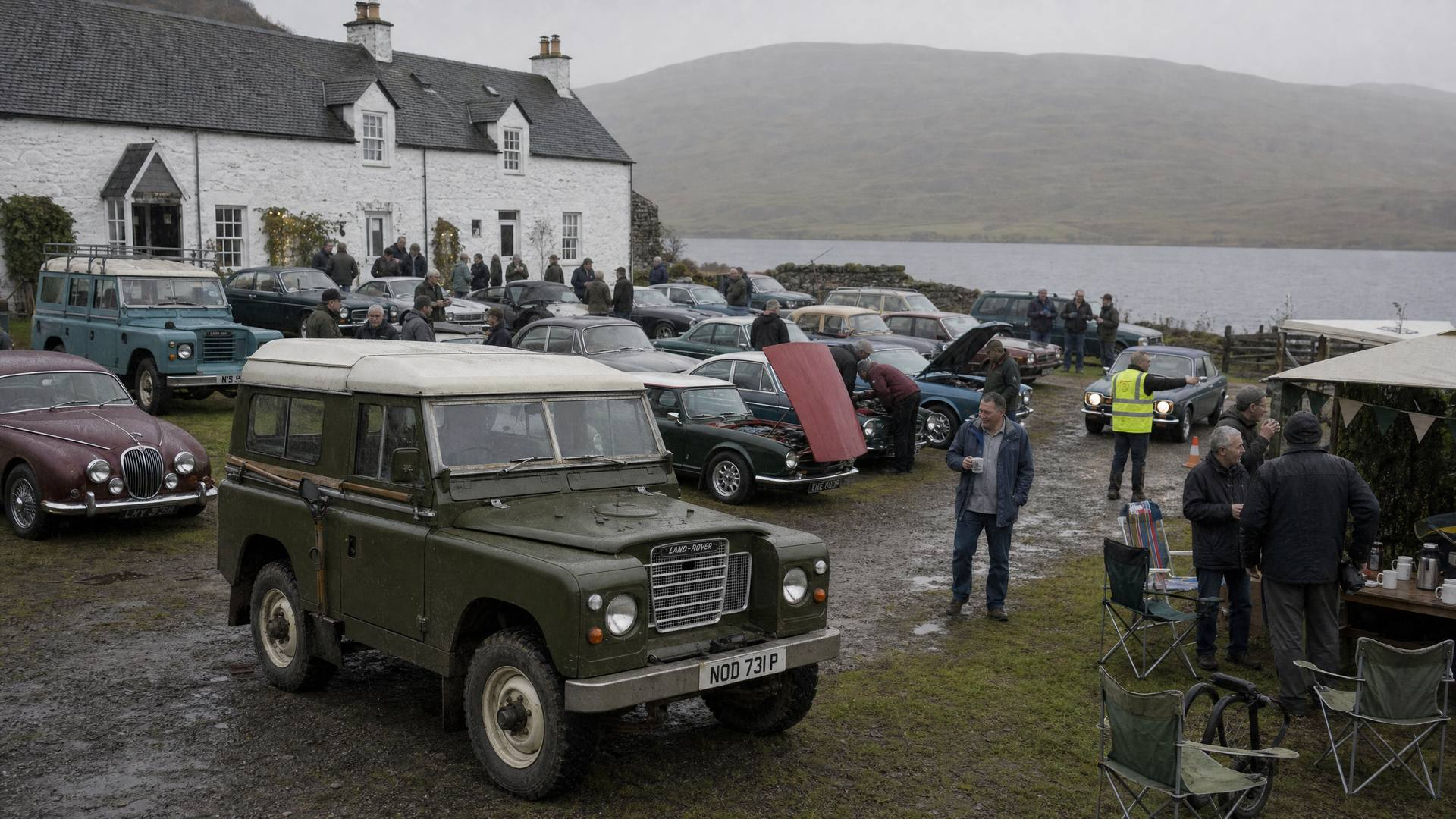
The car park age tribunal
Trouble begins when a modern classic arrives. A tidy early Mazda MX5, Volkswagen Golf GTI or Porsche 996 rolls in and half the car park welcomes it warmly. The other half narrows its eyes. To them, a car is not a classic if it has reliable fuel injection, effective ventilation or a radio that remembers its stations. It must first serve a lengthy apprenticeship involving rust, poor demisting and at least one obsolete bulb.
This debate is never resolved because nobody agrees what the word classic means. Age, rarity, design, nostalgia and cultural significance are all put forward, usually by people defending whatever they own. The twenty year old Porsche is dismissed as a used car by a man whose own classic was considered scrap when he bought it. Give it another decade and he will claim he always knew the Porsche would become collectible.
The rolling project gets a pass
The unfinished car is granted special protection. It arrives wearing primer, one mismatched wheel and an exhaust note that suggests a saucepan has joined the system. The owner climbs out looking tired but delighted. He was fitting the seats at midnight, the passenger window is stored in the boot, and the drive to the pub is the first time the car has moved under its own power since a government nobody remembers.
Nobody criticises this car. They gather around it, offer spare parts and recommend three different people called Dave who can sort the carburettors. Even the concours crowd softens. Every enthusiast knows how much stubbornness it takes to return a dismantled project to the road. Perfection can be bought. Turning up in something you rebuilt while lying on a cold concrete floor earns a more lasting sort of respect.
Late arrival means bin duty
Anyone arriving after eleven receives whatever space remains, usually beside the bottle bins or behind a modern family crossover the size of a bungalow. Latecomers offer explanations as they get out. The choke was playing up. A fuse failed. The satnav did not understand the postcode. One Triumph owner announces that he stopped to help another classic, which may be true but is also the motoring equivalent of arriving with a note from your mother.
The late arrival then performs the walk of mild shame towards the main group, keys swinging visibly in one hand so everyone knows which car is theirs. This matters. Without the keys, they are simply a person emerging from the bins. Within minutes, however, somebody hands them a mug, asks what held them up and begins a forty minute account of a fuel pump problem in 1996. They are back among friends.
When everybody has to leave
Departure is where the hierarchy loses all discipline. Throughout the morning, cars have been ranked by paint depth, rarity and the number of people photographing them. Now they have to start. Bonnets rise across the car park like a mechanical dawn chorus. Owners pump pedals, adjust chokes and stare at temperature gauges with the concentration of surgeons.
The immaculate MGB produces one firm click and nothing else. The Ferrari must cross the speed bump at an angle normally used by canal boats entering locks. The rolling project starts immediately, to everyone’s delight and its owner’s complete astonishment. It leaves in a puff of smoke while three people push the MGB, and the man from the prime space insists the battery is fine because it was new in 2019.
What really earns the best spot
For all the quiet judgement, the pub car park hierarchy is mostly affectionate nonsense. The most valuable car is not automatically the most interesting, the shiniest owner is not necessarily the happiest, and the person with oil on their sleeve often has the best story. What people really remember is the car that gets used, the owner who lets a child sit behind the wheel and the stranger who lends a spanner without turning it into a lecture.
And yes, the MGB will be in the prime space again next month. He will say he only arrived five minutes before everybody else, despite the dew having been wiped from the bonnet and a completed crossword sitting on the passenger seat. Let him have it. He has earned that patch of gravel through preparation, persistence and an alarming willingness to leave home before sunrise. Besides, somebody needs to tell the Ferrari where the speed bump is.

Have you ever wondered how to take the best photographs of your classic car? Perhaps you are...
We were over the moon that our article on the best classic car museums in the UK went down so well...
Classic car people do not always enjoy being told uncomfortable things. We will happily spend forty...